

Paghulagpos! Contemporary Women’s Movement

Updated: Feb 5, 2025
In the 1960s, escalating poverty, government debt, imperialism, feudalism, and fascism fueled a growing sense of nationalism among students and the populace, leading to the First Quarter Storm of 1970. The series of demonstrations and protests led by Kabataang Makabayan (KM) and the Samahang Demokratiko ng Kabataan (SDK) reached thousands with the battle cry: Makibaka! Huwag Matakot!
The EDSA People Power Revolution would not have been successful in ousting the Marcos dictatorship without the active participation of women on many levels. One of the most influential groups from 1983-1986 was the Alliance of Women for Action Towards Reform (AWARE). This alliance helped stage one of the most prominent women's rallies on 28 October 1983, weeks after Ninoy Aquino's assasination.
The following organizations stood out in their feminist and women’s discourses that had influenced the growth of social movements, particularly the women’s movement.
MAKIBAKA

Lorena Barros
(18 March 1948 – 24 March 1976)
Was a Filipino activist. She founded the Malayang Kilusan ng Bagong Kababaihan or MAKIBAKA.
A brilliant young woman named Maria Lorena Barros (March 18, 1948 - March 24, 1976), a poet, feminist, and activist, was a University of the Philippines Anthropology student when she led the formation of MAKIBAKA (Malayang Kilusan ng Bagong Kababaihan) in 1970 to address the root cause of women’s oppression and the cause of national liberation. In her words, “The new woman, the new Filipina, is first and foremost a militant.”

Lorena Barros
Lorena Barros at ang mga kasama sa isang piket sa timpalak-pagandahan na Bb. Pilipinas sa
harap ng Araneta Coliseum, Cubao, Lungsod Quezon, Abril 18, 1970

MAKIBAKA
Isang kilos-protestang nilahukan ng MAKIBAKA bago ang deklarasyon ng batas-militar, circa 1972
MAKIBAKA’s official inauguration was in 1970 when they picketed the Binibining Pilipinas Pageant in front of the Araneta Coliseum against the objectification and commercialization of women. The Diliman Commune was another major event that MAKIBAKA actively participated in.
The proclamation of Martial Law in 1972 worsened the injustices in the country; this would lead Laurie to actively join the Nationalist Democratic Front (NDF) until she died in an encounter in Mauban, Quezon, in 1976. MAKIBAKA continued its mission and later changed its name to Makabayang Kilusan ng Bagong Kababaihan.

Rally at Mendiola, with Malacañang visible at the far end of the road, in front of San Beda College and Centro Escolar University. Various organizations and sectors joined the protest.

Rally at Liwasang Bonifacio before the Declaration of Martial Law, led by Samahang Demokratikong Kabataan (SDK) and joined by Kabataang Makabayan (KM) members and various SDK school chapters from Metro Manila. The protest voiced strong opposition to the impending Marcos dictatorship.
Katipunan ng Bagong Pilipina (KaBaPa)

KABAPA
From L-R: Karina Constantino David, Trinidad Domingo of Katipunan ng Bagong Pilipina (KABAPA), Zeneida “Nini” Quezon Avanceña, and Teresita Quintos Deles
The birth of Katipunan ng Bagong Pilipina (KaBaPa), , illustrates the nexus of social movement and women’s organizing. It was first launched on March 8, 1975, with 2,000 women from rural areas of Luzon.
Katipunan ng Bagong Pilipina (KABAPA) rally

49th anniversary of Katipunan ng Bagong Pilipina (KABAPA)
With its orientation towards the future, KaBaPa founded Bagong Sibol (New Spring) in 1979 and Pambansang Kalipunan ng mga Manggagawang Impormal sa Pilipinas (PATAMABA) or the National Network of Informal Workers in the Philippines in 1991. KaBaPa‘s thrust is to educate grassroots women, train them in good community leadership, organize cooperatives, and undertake other projects for women. It also supports GO-NGO collaboration and educational campaigns on social issues and provides medical and social services. The members are composed of peasants, urban poor workers, and home-based workers.
PILIPINA
Honoring Pinay’s founding Mothers- Teresita Quintos -Deles, Remedios Rikken, Rina David-Jimenez
PILIPINA was established in 1981 by women social development workers from various non-governmental organizations, people’s organizations, the academe, and media. Its founding members were united with the objective of seeking explicit recognition of the women question in social development work. PILIPINA rightfully gained its status as a national organization of women with 10 city and provincial chapters across the country.

Launch of Gender in Islam training manual
PILIPINA believes in enhancing women's participation and integrating the gender perspective in the struggle for social transformation. It actively participated in dismantling the twenty-year dictatorial regime and the restoration of democracy and peace in the country.
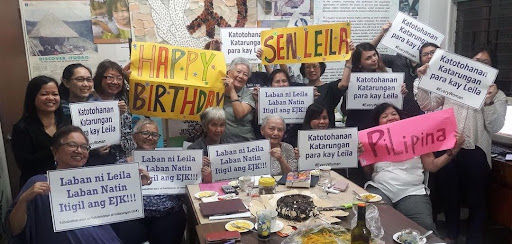
Birthday of Senator Leila de Lima
PILIPINA’s recent initiatives to strengthen women’s participation in politics include lobbying and constituency-building for the successful passage of the Magna Carta of Women. The organization also took part in the formation of EveryWoman.Ph, a community of women that collectively pushbacks misogyny, defends democratic political spaces, and upholds women’s human rights.

PILIPINA
Solidarity night of women's groups "Pilipina" and "Pandayan Women" on Day 6 of " Prayer and Fasting" ( Dasal at Ayuno ) at the People Power Monument. Teresita Quintos Deles in the face of threats of charter change to formalize dictatorship and corruption of the political elite exhorts the young people to remember the historic "People Power."
Katipunan ng mga Kababaihan para sa Kalayaan (KALAYAAN) (League of Women for Liberation)
Katipunan ng mga Kababaihan para sa Kalayaan (KALAYAAN) was founded on 6 July 1983 in Quezon City. KALAYAAN called for a women’s movement with an articulated feminist perspective. It believes that any long-term cultural, social, political and economic transformations in Philippine society engendered by historical incidences of colonialism and feudalism must address the imbalances in these areas within the context of the gender-based inequities.

Women Artists Empowering Women
KALAYAAN project in cooperation with the National Commission on Culture and the Arts (NCCA).
The opening was September 18, 1995, at the Contreras Sculptures Gallery, SM Megamall.
Like many pioneering organizations, its projects have become legacies in the women’s movement. It is a founding member of GABRIELA, WomanHealth Philippines, G-10 network and WeDPro. It organized Feminist Friday Forums at the UP Faculty Center, which tackled issues such as domestic violence, reproductive rights, non-sexist education, the debt crisis, and other pressing issues.

KALAYAAN
KALAYAAN in anti-bases rally
Kalayaan, as an organization, also established the first non-degree feminist school, The Lorena Barros and Estrella Consolacion Feminist School. It has supported women’s creativity through its BAI publication, published books of poetry, art exhibits, and cultural presentations.
KALAYAAN Feminist School
Kalayaan ng Kababaihan, Kalayaan ng Bayan, Sabay Nating Ipaglaban!
GABRIELA (General Assembly Binding Women for Reforms, Integrity, Equality, Leadership and Action)
On March 10-11, 1984, women representing various organizations gathered at St. Scholastica’s College in Manila to affirm their commitment to serving women and the people and fighting fascism and the Marcos dictatorship. They called themselves GABRIELA in recognition of Gabriela Silang. Sen. Tecla San Andres Ziga (1906-1992) served as GABRIELA’s first chairperson.
GABRIELA rally
GABRIELA has launched multiple campaigns and projects on policy and legal advocacy to promote women’s rights and welfare, provide direct services to marginalized women, counsel survivors of Violence Against Women (VAW), provide paralegal services, educate, and do other important work. It has given birth to the Gabriela Women’s Party, a women’s partylist seated in Congress that functions independently from GABRIELA.

March of Women Laban sa Kahirapan at Karahasan

GABRIELA
GABRIELA founding assemby

Beauty Queens turned activists Maita Gomez (R) and Nelia Sancho (L)
GABRIELA has become the most active and far-reaching women’s coalition. It has major organizations in the country, as well as members and chapters in many countries that fight for a sovereign Philippines, equal value to women in production and ownership, and a government where women’s rights are respected, devoid of patriarchal values and violence.
Makibaka! Huwag Matakot!
References:
de Dios, Aurora Javate. "Participation of Women‘s Groups in the Anti-Dictatorship Struggle: Genesis of a Movement." UP Center for Women‘s Studies Journal, 1996.
Patamaba Youth. “PATAMABA Youth.” patamaba.org, 2023.
Taguiwalo, Judy. "The Women of the First Quarter Storm of 1970: Fully Engaged in the Making of History (Part 2 of 2)." Manila Today, 18 Feb. 2015, manilatoday.net.
University of the Philippines Office for Initiatives in Culture and Arts. "First Quarter Storm Timeline." UPDate, vol. 4, no. 1, Jan.-Mar. 2021.
Espeso, Zazel. "Lorena Barros: Revolutionary Philippine Poetry and Her Unrelenting Optimism for National Liberation." Philippine Collegian, 9 Mar. 2024.
Hernando, Pauline Mari. “Ang Rebolusyonarya: Kasaysayan ng Makabayang Kilusan ng Bagong Kababaihan (MAKIBAKA) 1970-2022.” UP Press, 2024.
Hernando, Pauline Mari. “Lorena: Isang Tulambuhay.” University of the Philippines Press, 2018.
Ka Trining. Messenger Interview. 1 June 2024.
KaBaPa Brochure. KaBaPa, 1978.
Patamaba Youth. “PATAMABA Youth.” Patamaba.org, 2023.
Yang, Elizabeth. "About Pilipina." 2024.
KALAYAAN brochure. Kalayaan, 1991.
GABRIELA. GABRIELA Alliance of Filipino Women Brochure.
Libang, Gertrudes. Personal Interview. 2 April 2024.


Comments